Running a successful short-term rental business is no longer as simple as putting a property on a booking platform, choosing a nightly rate, and waiting for reservations to come in. Travelers can compare dozens of properties within minutes, while rates, demand, seasonality, reviews, amenities, and booking windows constantly influence which properties attract attention.
For property managers, this creates a challenge that goes far beyond asking, “What should we charge?” You also need to understand how the property compares with relevant competitors, whether its strongest features are being communicated effectively, and whether marketing is supporting the pricing strategy.
That is where pricing and marketing begin to overlap. Pricing helps determine how competitively a property enters the market, while marketing helps communicate why that property deserves attention at that price. When these two functions operate independently, property managers can end up making good decisions in isolation without taking full advantage of how those decisions could work together.
A stronger approach is to build a connected pricing and marketing tech stack where market intelligence, competitive benchmarking, property positioning, marketing execution, revenue insights, and performance analysis reinforce one another. The goal is not simply to choose a nightly rate; it is to create a strategy that helps a property remain competitive, visible, and well positioned in the market.
Key Takeaways
For property managers who want the quick version:
- Pricing and marketing should support one another. Competitive pricing gets a property into consideration, while strong marketing helps communicate its value.
- Relevant competitors matter more than broad averages. Amenities, capacity, reviews, property type, quality, seasonality, and other factors can influence where a property should be positioned.
- Changing a price does not automatically create visibility. Marketing is what helps communicate the opportunity to potential guests.
- Vacant nights are perishable inventory. Once an available date passes, the revenue opportunity disappears.
- Disconnected tools create hidden work. Switching between systems becomes increasingly inefficient as the portfolio grows.
- Better data can improve owner conversations. Competitive context and revenue projections help make recommendations easier to explain.
- A strong tech stack is not about having more software. It is about creating better-connected decisions and workflows.
What Is a Short-Term Rental Tech Stack?
A technology stack, commonly called a tech stack, is the collection of software and digital tools a short-term rental company uses across different parts of the business. Depending on the company, that may include property management software, reservation systems, pricing tools, market intelligence platforms, social media tools, analytics, reporting software, guest communication systems, and other specialized technology.
The important distinction is that not every tool in the stack performs the same job. A property management system may handle reservations and operational information, while another platform may focus on pricing intelligence, marketing, reporting, or analysis. The value of a tech stack comes from how well those different functions support the overall business.
Problems often appear when every part of the strategy exists in a separate system. A property manager may review competitors in one place, evaluate pricing somewhere else, locate property photos in another system, create promotional content in a design platform, schedule marketing through another tool, and then prepare reports separately.
Each individual task may be manageable, but the friction between them becomes more noticeable as the portfolio expands. What works comfortably for five properties can become inefficient across 25, 50, or 100.
A stronger STR tech stack should therefore help reduce the distance between information, decisions, and execution. The goal is not to replace every operational platform with one piece of software; it is to make strategic work easier to understand, repeat, and act on.
Pricing Is About More Than Choosing a Nightly Rate
Pricing is one of the most important strategic decisions a property manager makes. A rate that is too high can make a property less competitive, while a rate that is too low may generate bookings but leave potential revenue on the table.
However, determining an appropriate price requires more context than simply looking at the average nightly rate in a destination. Two properties may have the same bedroom count and still offer very different experiences.
For example, one three-bedroom vacation rental might offer:
- A private pool
- Excellent guest reviews
- Updated interiors
- Premium outdoor entertaining space
- A dedicated workspace
- Capacity for eight guests
Another three-bedroom property may have fewer amenities, older interiors, weaker reviews, and room for only six guests. Although the two properties appear similar on paper, travelers may perceive their value very differently.
That is why pricing decisions become more useful when they are based on relevant competitive context, not just broad market averages.
Why Competitive Benchmarking Matters
Competitive benchmarking helps property managers understand where a property sits among the alternatives travelers are realistically considering. Instead of relying on a single market average, managers can look at characteristics that influence both pricing and guest perception.
Relevant factors may include:
- Number of bedrooms
- Guest capacity
- Property type
- Amenities
- Review scores
- Current nightly rates
- Minimum-stay requirements
- Seasonal demand
- Length of stay
- Available nights
- Occupancy assumptions
- Local market conditions
- Overall property quality and positioning
This changes the question from “What is the average rate in this market?” to “Where should this particular property sit within its true competitive set?”
That distinction can reveal opportunities that broad averages miss. A premium property may be priced too closely to average competitors, or a higher-priced property may actually be well positioned when compared with similar options that offer equivalent amenities, quality, and guest experience.
Pricing intelligence creates stronger context for the decision, but price alone still cannot communicate the full value of the property.
A Great Price Cannot Help a Property Nobody Notices
Imagine that a property manager has carefully evaluated the market and selected a competitive rate. Seasonality has been considered, relevant competitors have been reviewed, and the pricing strategy makes sense.
Now imagine that the property’s marketing is not communicating its strongest selling points. The best amenity appears late in the photo sequence, a beautiful outdoor space rarely appears in promotional content, excellent guest feedback is never reused, and the property receives very little exposure outside the booking platforms.
Then a cancellation creates availability for the following weekend, but nobody promotes those newly available dates.
The pricing decision may be strong, yet potential guests still need to discover the opportunity and understand why the property deserves consideration. That is why pricing and marketing should support one another.
Pricing creates the offer. Marketing helps communicate the opportunity.
Pricing Gets You Competitive. Marketing Helps You Get Chosen.
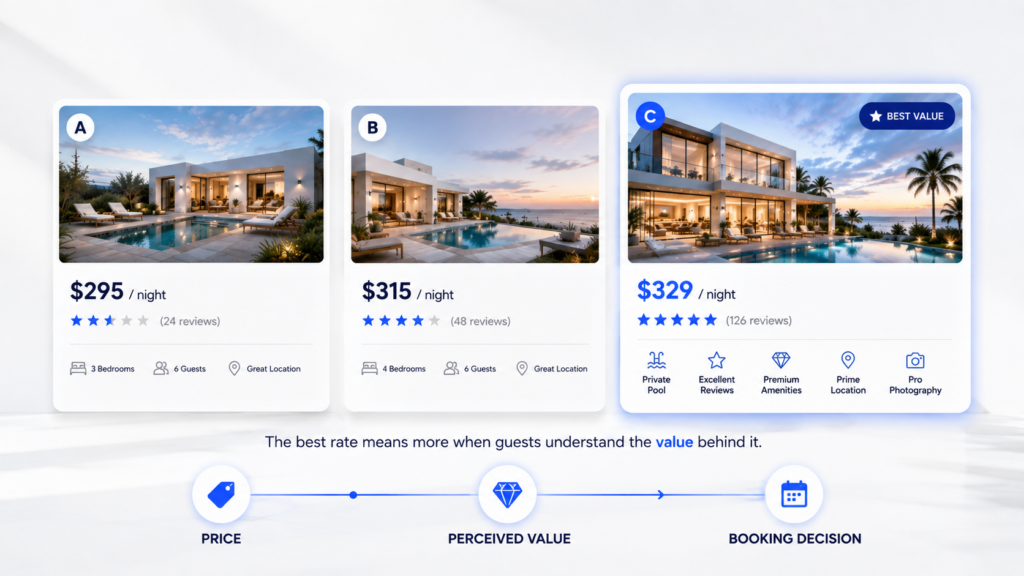
Consider a traveler comparing three similar vacation rentals:
- Property A: $295 per night
- Property B: $315 per night
- Property C: $329 per night
At first glance, Property A might seem like the obvious value because it has the lowest nightly rate. Once the traveler looks more closely, however, the decision can change.
Suppose Property C has professional photography, exceptional reviews, a private pool, a premium outdoor area, a better location, and additional amenities that fit the traveler’s needs. The $34 difference may suddenly feel completely reasonable.
That is the difference between price and perceived value. Pricing determines what the stay costs, while marketing helps travelers understand what they receive in return.
The strongest strategy addresses both.
Your Property Is Competing Before the Guest Ever Clicks
Travelers often begin forming opinions before they ever open the full property page. When browsing a booking platform, guests may compare multiple options within seconds based on photography, nightly rate, reviews, amenities, location, availability, and overall presentation.
That means pricing and presentation are influencing the same decision almost immediately. An attractive rate may not be enough if the property’s photography fails to communicate quality, while beautiful imagery may not overcome a price that feels disconnected from comparable options.
Amenities create the same challenge. A property may offer an exceptional pool, workspace, entertainment area, waterfront view, or family-friendly setup, but those features cannot influence the booking decision if travelers do not notice them.
A strong strategy therefore considers both how the property is priced and how its value is communicated.
What Happens When Pricing and Marketing Work Together?
The value of a connected STR tech stack does not come from simply having access to both pricing technology and marketing technology. The greater opportunity comes from reducing the distance between insight and action.
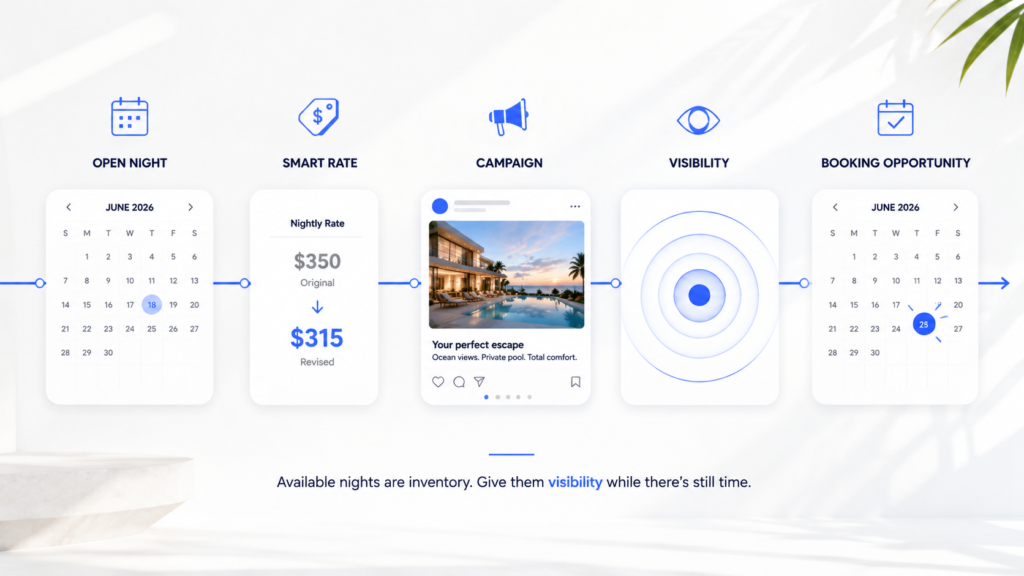
Consider an unexpected cancellation that creates a two-night opening for the following weekend. In a fragmented workflow, a property manager may need to notice the opening, review competitive rates, decide whether the price should change, locate relevant property information and photos, create marketing content, prepare campaign copy, schedule promotional posts, and then monitor what happens.
None of those steps is particularly complicated by itself. The challenge is that every additional platform, login, manual handoff, and repetitive process creates friction.
In a more connected workflow, the vacancy becomes a strategic opportunity. Competitive information provides context for the pricing decision, existing property information supports the marketing message, and promotional activity can begin while the booking window is still relevant.
The benefit is not automation simply for the sake of automation. It is better coordination between market insight, pricing decisions, and marketing execution.
Your Pricing Strategy Should Influence Your Marketing Strategy
Different pricing situations should lead to different marketing responses. Instead of treating marketing as a completely separate calendar of generic posts, property managers can use pricing and market context to determine what deserves attention.
Premium Positioning
If a property is priced above nearby competitors because it offers stronger amenities, superior reviews, or better overall quality, its marketing should clearly communicate those differences. Premium pricing becomes easier to understand when potential guests can immediately recognize the additional value.
Last-Minute Availability
When a cancellation creates an unexpected opening, the response does not have to stop with a pricing adjustment. Marketing can highlight that previously unavailable dates have opened and create visibility while the booking window is still useful.
Seasonal Opportunity
If market signals suggest an upcoming increase in demand, promotional campaigns can begin before the market becomes saturated. Pricing and marketing can then support the same seasonal strategy.
Strong Guest Feedback
If guests repeatedly praise a particular feature, such as the view, pool, outdoor area, location, or workspace, that feedback can help shape future promotional messaging.
Specific Guest Segments
If a property tends to appeal strongly to families, remote workers, couples, or larger groups, marketing can emphasize the amenities and experiences that matter most to those travelers.
The more closely marketing reflects the actual competitive position of the property, the more useful it becomes.
Marketing Insights Can Strengthen Property Positioning
The relationship works in both directions. Pricing intelligence can influence marketing strategy, while marketing performance and guest feedback can reveal which property features appear to matter most.
Suppose content featuring an ocean view consistently receives stronger engagement than content focused on the interior. Guests may repeatedly mention the outdoor kitchen in five-star reviews, or posts highlighting the workspace may perform particularly well with a specific audience.
Those patterns can help property managers better understand how guests perceive the property. That insight can then influence photography priorities, promotional messaging, amenity investments, social campaigns, owner recommendations, and overall positioning.
Over time, the process becomes a continuous feedback loop:
Market Intelligence → Pricing → Positioning → Marketing → Performance Insights → Optimization
Instead of treating each area as an isolated task, one decision begins informing the next.
Vacancy Nights Are Inventory
One of the clearest examples of pricing and marketing working together is last-minute availability. An unbooked night is perishable inventory because once that date passes, the opportunity to earn revenue from it disappears permanently.
A property manager may respond by adjusting the nightly rate, which can make the property more competitive. However, changing the rate does not automatically make travelers aware that the dates are available.
Marketing provides that additional layer of visibility. Depending on the property and booking window, a newly available night could become:
- A last-minute weekend promotion
- A seasonal campaign
- A limited-availability message
- A targeted social media post
- A property-specific promotional campaign
- An offer centered around a popular amenity
The relationship is straightforward: pricing helps shape the offer, while marketing helps put the opportunity in front of potential guests.
A Connected Tech Stack Helps Property Managers Become More Proactive
Property management is naturally operational, which means urgent tasks can easily consume the day. Guest questions, maintenance requests, reservation changes, cleaning coordination, owner communication, pricing reviews, marketing needs, and review responses all compete for attention.
As a result, strategic work can easily be delayed. Marketing may happen only when someone finds extra time, pricing may receive additional attention only after bookings slow down, and promotional activity around vacancies or seasonal opportunities may begin later than ideal.
That is reactive management.
A stronger technology stack can help property management teams create more repeatable processes around market analysis, pricing evaluation, property positioning, promotional campaigns, revenue projections, reporting, and optimization. Instead of constantly reacting to what happened yesterday, managers gain more opportunities to prepare for what could happen next.
Better Data Creates Better Owner Conversations
Connected pricing and marketing insights can also improve communication between property managers and owners because owners understandably want to know why changes are being recommended.
There is a meaningful difference between simply saying, “I think we should change the rate,” and supporting the recommendation with information such as:
- Current pricing strategy
- Proposed pricing changes
- Relevant competitive rates
- Occupancy assumptions
- Available nights
- Seasonal context
- Revenue projections
- The reasoning behind the recommendation
The second approach turns the conversation into a strategy discussion rather than a request to trust an opinion. Competitive context and visual revenue projections can help managers show owners how a recommendation was developed and what the potential impact may look like.
This is especially valuable when discussing changes that affect revenue expectations, seasonal strategy, or the competitive position of a property.
Better Reporting Builds More Than Reports
Reporting is often treated as an administrative requirement, but it can also become an important relationship tool. When owners understand what their property manager is evaluating, testing, and recommending, they gain greater visibility into the strategy behind the property.
That helps demonstrate value beyond operational responsibilities. A strategic property manager is also asking whether the property is priced appropriately, how it compares with relevant competitors, which opportunities deserve additional marketing, and what potential changes could mean for projected revenue.
Technology that makes those conversations clearer can help property managers communicate their strategic role more effectively.
The Hidden Cost of Fragmented Technology
Software subscription costs are easy to see, but the operational cost of fragmentation is much harder to measure. A few minutes spent switching systems may seem insignificant until those minutes are repeated across dozens of properties and hundreds of tasks.
Fragmented workflows can create unnecessary time spent:
- Logging into multiple platforms
- Searching repeatedly for the same property information
- Downloading and uploading photos
- Copying data between systems
- Recreating reports
- Building campaigns manually
- Moving information between tools
- Checking whether information matches
- Switching between property accounts
Individually, these tasks may not look like major inefficiencies. Collectively, they can consume significant time and make growth increasingly difficult.
A more connected technology strategy helps reduce unnecessary repetition while allowing each platform to continue serving the purpose it was designed for.
Scaling a Portfolio Without Scaling the Chaos
Property management companies often measure growth by the number of properties they serve, but true scalability also depends on how efficiently teams can apply strategy across that portfolio.
If a company doubles the number of properties it represents, marketing workload, pricing analysis, reporting preparation, and other strategic tasks should not necessarily have to double at exactly the same rate.
Technology can create operational leverage by making key workflows easier to repeat across multiple properties. Those workflows may include:
- Competitive analysis
- Pricing evaluation
- Property positioning
- Marketing campaign creation
- Vacancy promotion
- Revenue projections
- Owner communication
- Performance review
The more repeatable these processes become, the easier it is to maintain a consistent approach across a growing portfolio.
Importantly, this does not mean the pricing or marketing platform is managing the property’s booking-platform listing. It means property management teams can apply pricing, marketing, and strategic processes more efficiently across the properties they already manage.
The Goal Is Not More Technology
A better tech stack does not automatically mean more software. Property managers already have access to a wide range of technology, so the real challenge is choosing systems that genuinely improve the way the business makes decisions and carries out strategic work.
A useful tool should help answer questions such as:
- Does this help us understand the market better?
- Does it help us make stronger pricing or marketing decisions?
- Does it help us turn insights into action faster?
- Does it reduce repetitive work?
- Does it improve the way we communicate strategy?
- Does it make portfolio-wide processes easier to repeat?
If the answer is no, another platform may simply become another login. The objective is not to collect software; it is to build a more effective system around the work that actually matters.
What Should an STR Pricing and Marketing Tech Stack Actually Do?
A strong pricing and marketing tech stack should support the strategic cycle of understanding the market, evaluating pricing, positioning properties, creating marketing opportunities, communicating recommendations, and learning from performance.
1. Understand the Market
Property managers need visibility into relevant competitors, pricing patterns, seasonality, amenities, reviews, capacity, and other market conditions that may influence demand.
2. Benchmark the Property
The property should be compared with competitors that realistically target similar travelers rather than relying only on broad market averages.
3. Evaluate Pricing Decisions
Managers should be able to examine how potential changes to rates, occupancy assumptions, available nights, length of stay, seasonality, and other variables could affect the strategy.
4. Strengthen Property Positioning
Competitive context should help managers understand where a property belongs in the market and which differentiators deserve greater attention.
5. Turn Property Information Into Marketing
Existing photos, amenities, reviews, available dates, and property features can provide the foundation for more relevant marketing campaigns.
This is marketing the property, not managing or editing the property’s OTA listing.
6. Respond to Opportunities Quickly
Vacancies, seasonal demand, strong guest feedback, promotions, and other timely opportunities should be easier to turn into relevant campaigns.
7. Maintain Consistent Visibility
Marketing becomes more effective when it operates as a repeatable process instead of something that happens only when the team has extra time.
8. Communicate Strategy Clearly
Competitive information and revenue projections can help owners understand the reasoning behind pricing and strategic recommendations.
9. Learn and Optimize
Market information and performance insights should continue influencing the next pricing, positioning, and marketing decision.
When these functions reinforce one another, technology becomes more valuable than any individual feature.
Building the Ultimate Property Strategy Requires More Than One Tactic
There is no single price, campaign, photograph, amenity, or technology platform that guarantees short-term rental success. A beautiful property can still be underpriced, while a competitively priced property can still receive weak marketing support. Strong photography can attract attention but fail to communicate the features travelers value most, and effective marketing can create interest while poor pricing reduces competitiveness.
Exceptional reviews can strengthen trust, but their impact is limited if they never inform the property’s broader marketing strategy. Strong performance comes from several elements working together rather than one isolated tactic.
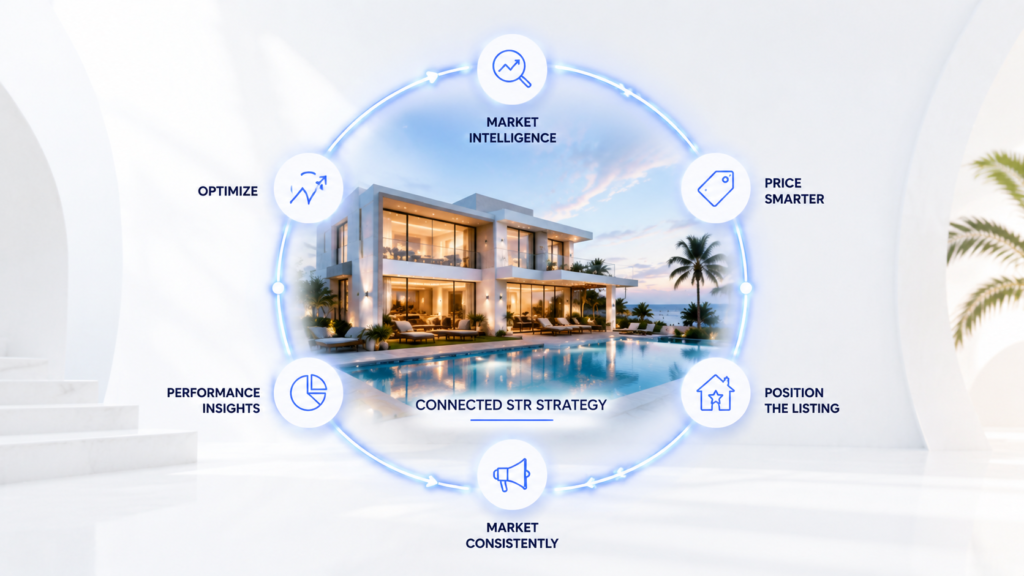
The strongest strategies combine:
- Market intelligence
- Pricing
- Positioning
- Content
- Visibility
- Guest perception
- Performance analysis
- Continuous optimization
That is why a connected STR tech stack matters. Strong results are not created by one tool; they are created by better decisions working together.
Where STR ToolBox Fits Into the Strategy
STR ToolBox is designed around the idea that pricing intelligence and property marketing should work more closely together. Rather than treating competitive analysis, pricing decisions, campaign creation, revenue projections, and marketing execution as completely separate activities, the platform helps property managers create a more connected strategic workflow.
Competitive information can provide context for pricing decisions, while pricing can influence how a property should be positioned and promoted. Property photos, features, amenities, reviews, and availability can support marketing campaigns, while revenue projections can help make owner conversations more informed.
The workflow becomes more connected:
Insight → Strategy → Marketing Action → Communication → Optimization
It is also important to be clear about what STR ToolBox is not intended to do. STR ToolBox does not manage, edit, publish, or replace the property’s listing on booking platforms or OTAs. Property managers continue using their existing operational and listing-management systems for those functions.
STR ToolBox instead focuses on helping property managers strengthen the pricing, marketing, revenue, and strategic decision-making surrounding those properties.
Frequently Asked Questions
What is an STR tech stack?
An STR tech stack is the collection of software and technology a short-term rental company uses across different parts of the business. Different tools may support reservations, operations, pricing, market analysis, marketing, reporting, guest communication, or other functions, and not every platform performs every role.
Does STR ToolBox manage property listings on booking platforms?
No. STR ToolBox does not manage, edit, publish, or replace property listings on booking platforms or OTAs. Property managers continue using their existing property management and listing systems for those functions.
STR ToolBox focuses on pricing intelligence, property marketing, revenue insights, and strategic workflows that support the properties being managed.
Why should pricing and marketing work together?
Pricing determines how competitively a property enters the market, while marketing helps communicate why travelers should choose it. A strong strategy considers both the nightly rate and the perceived value guests associate with the property.
What should property managers consider when comparing rates?
Relevant comparisons may include bedrooms, guest capacity, property type, amenities, review scores, nightly rates, minimum stays, seasonality, length of stay, property quality, and competitive positioning. The goal is to compare a property with alternatives travelers are realistically considering.
Can marketing help with last-minute vacancies?
Yes. Adjusting the rate may improve competitiveness, but marketing can create additional awareness around newly available dates. A stronger last-minute strategy considers both the offer and the visibility of the offer.
How can a connected tech stack help property management companies scale?
Connected technology can reduce repetitive steps and create more standardized workflows around pricing, marketing, reporting, vacancy promotion, and portfolio-wide strategy. This can help teams apply consistent processes across more properties without increasing manual strategic work at exactly the same rate.
A Smarter STR Strategy Starts With Connected Decisions
Short-term rental success rarely comes from one isolated decision. Better pricing can help, stronger marketing can help, clearer revenue projections can help, and better competitive insight can help, but the greater advantage appears when those decisions begin reinforcing one another.
Pricing intelligence helps property managers understand where a property sits in the market, while marketing helps communicate the value behind that position. Performance insights provide context for the next decision, and better reporting can make the strategy easier to explain to owners.
That is the real purpose of a connected pricing and marketing tech stack: not more tools, but better alignment; not more dashboards, but better decisions; and not more busywork, but a stronger strategy.
Build a More Connected STR Strategy
STR ToolBox helps property managers bring pricing intelligence, property marketing, revenue insights, and strategic workflows closer together so market information can more easily become meaningful action.
It works alongside the systems property managers already use to operate their properties, providing tools focused on helping teams make smarter pricing and marketing decisions.
See how pricing and marketing can work better together with STR ToolBox.
🚀 Market Smarter. Price Smarter. Book More!
🌐 Explore STR ToolBox at str-toolbox.com
Follow STR ToolBox for more short-term rental pricing, marketing, and growth insights:
- Facebook: STRToolBox
- Instagram: @strtoolboxapp
- LinkedIn: STRToolBox
Join the STR ToolBox Community
Connect with the STR ToolBox community and stay involved in conversations, updates, and ideas around smarter STR growth.